Durable Remission in BRCA2-Mutated, PD-L1–Overexpressing Pancreatic Cancer with Multimodal Precision Therapy: A Case Report

 https://doi.org/1234
Keywords:
Pancreatic ductal adenocarcinoma Pancreatic Cancer Immunotherapy Precision Therapy PD-L1 PD-1 Therapy Case reportAbstract:
Background: Pancreatic ductal adenocarcinoma (PDAC) remains one of the most lethal malignancies, with a 5-year survival rate of only 13.3%. New effective strategies are needed for PDAC, including those with actionable mutations that may confer sensitivity to targeted therapies.
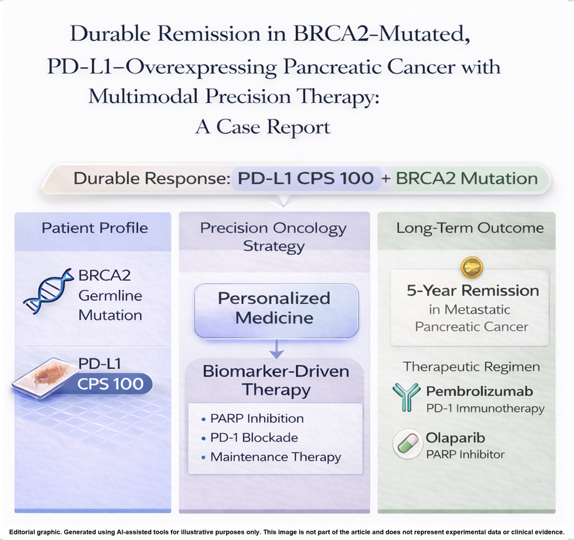
Patient Presentation: We describe a 60-year-old man (never-smoker, no significant alcohol use) with a strong family cancer history who presented with acute pancreatitis. Workup revealed PDAC in the distal pancreas and germline testing identified a pathogenic BRCA2mutation. The patient had borderline resectable disease and enrolled in a phase II clinical trial of modified FOLFIRINOX plus losartan with stereotactic body radiation therapy (SBRT) and nivolumab (anti–PD-1) prior to surgery. He then underwent distal pancreatectomy and splenectomy, achieving a complete resection. Pathology showed near-complete response (only a single 1 mm residual tumor focus in one lymph node, ypT0N1). One month postoperatively, surveillance MRI detected a new solitary liver lesion. Biopsy confirmed metastatic PDAC with PD-L1 combined positive score (CPS) = 100. The liver metastasis was treated with percutaneous microwave ablation. Shortly thereafter, the patient was started on maintenance therapy with a PARP inhibitor (olaparib) and PD-1 inhibitor (pembrolizumab).
Outcome: The patient remains in clinical remission, now over five years since the detection of the liver metastasis. He has no evidence of disease on serial MRI and PET/CT imaging and continues on maintenance olaparib and pembrolizumab.
Statement of Significance: This case illustrates an exceptional and durable response in advanced PDAC through a genomically guided, multimodal treatment strategy. The integration of platinum-based chemotherapy, targeted radiation, immunotherapy, and maintenance PARP inhibition was informed by the tumor’s unique BRCA2 mutation and high PD-L1 expression. Our findings support early molecular testing to identify PDACpatients suited for precision oncology approaches, which may contribute to more favorable outcomes.
Keywords: Pancreatic ductal adenocarcinoma, Pancreatic Cancer, Immunotherapy, Pre cision Therapy, PD-L1, PD-1 Therapy, BRCA2 Mutation, Homologous Recombination Deficiency
Abbreviations: Pancreatic ductal adenocarcinoma (PDAC), stereotactic body radiation therapy (SBRT), magnetic resonance imaging (MRI), combined positive score (CPS), homol ogous recombination deficiency (HRD), tumor mutational burden (TMB)
1. National Cancer Institute. Surveillance, Epidemiology, and End Results (SEER) Program (www.seer.cancer.gov) SEER*Stat Database: Incidence - SEER Research Data DCCPS, Surveillance Research Program, released April 2023, based on the November 2022 submission1975-2020 [cited 2023]. Available from: https://seer.cancer.gov/statfacts/html/pancreas.html.
2. Siolas D, Morrissey C, Oberstein PE. The Achilles' Heel of Pancreatic Cancer: Targeting pancreatic cancer's unique immunologic characteristics and metabolic dependencies in clinical trials. J Pancreatol. 2020;3(3):121-31. doi: 10.1097/JP9.0000000000000052. PubMed PMID: 33133736; PMCID: PMC7595263.
3. Rahib L, Smith BD, Aizenberg R, Rosenzweig AB, Fleshman JM, Matrisian LM. Projecting cancer incidence and deaths to 2030: the unexpected burden of thyroid, liver, and pancreas cancers in the United States. Cancer Res. 2014;74(11):2913-21. doi: 10.1158/0008-5472.CAN-14-0155 PMID - 24840647.
4. Zhen DB, Rabe KG, Gallinger S, Syngal S, Schwartz AG, Goggins MG, Hruban RH, Cote ML, McWilliams RR, Roberts NJ, Cannon-Albright LA, Li D, Moyes K, Wenstrup RJ, Hartman AR, Seminara D, Klein AP, Petersen GM. BRCA1, BRCA2, PALB2, and CDKN2A mutations in familial pancreatic cancer: a PACGENE study. Genet Med. 2015;17(7):569-77. doi: 10.1038/gim.2014.153 PMID - 25356972 PMC - PMC4439391.
5. Karimi A, Bogdani C, O'Dwyer E, Siolas D. Emerging innovations in theranostics for pancreatic neuroendocrine tumors. NPJ Precis Oncol. 2025;9(1):146. doi: 10.1038/s41698-025-00938-1 PMID - 40389624 PMC - PMC12089376.
6. Rodriguez NJ, Syngal S. Expanding access to genetic testing for pancreatic cancer. Fam Cancer. 2024;23(3):247-54. doi: 10.1007/s10689-024-00389-w PMID - 38733419 PMC - PMC11532997.
7. Wang Y, Zheng K, Xiong H, Huang Y, Chen X, Zhou Y, Qin W, Su J, Chen R, Qiu H, Yuan X, Wang Y, Zou Y. PARP Inhibitor Upregulates PD-L1 Expression and Provides a New Combination Therapy in Pancreatic Cancer. Front Immunol. 2021;12:762989. doi: 10.3389/fimmu.2021.762989 PMID - 34975854 PMC - PMC8718453.
8. Kindler HL, Hammel P, Reni M, Van Cutsem E, Macarulla T, Hall MJ, Park JO, Hochhauser D, Arnold D, Oh DY, Reinacher-Schick A, Tortora G, Algül H, O'Reilly EM, Bordia S, McGuinness D, Cui K, Locker GY, Golan T. Overall Survival Results From the POLO Trial: A Phase III Study of Active Maintenance Olaparib Versus Placebo for Germline BRCA-Mutated Metastatic Pancreatic Cancer. J Clin Oncol. 2022;40(34):3929-39. doi: 10.1200/JCO.21.01604 PMID - 35834777 PMC - PMC10476841.
9. Reiss KA, Mick R, O'Hara MH, Teitelbaum U, Karasic TB, Schneider C, Cowden S, Southwell T, Romeo J, Izgur N, Hannan ZM, Tondon R, Nathanson K, Vonderheide RH, Wattenberg MM, Beatty G, Domchek SM. Phase II Study of Maintenance Rucaparib in Patients With Platinum-Sensitive Advanced Pancreatic Cancer and a Pathogenic Germline or Somatic Variant in BRCA1, BRCA2, or PALB2. J Clin Oncol. 2021;39(22):2497-505. doi: 10.1200/JCO.21.00003 PMID - 33970687.
10. Reiss KA, Mick R, Teitelbaum U, O'Hara M, Schneider C, Massa R, Karasic T, Tondon R, Onyiah C, Gosselin MK, Donze A, Domchek SM, Vonderheide RH. Niraparib plus nivolumab or niraparib plus ipilimumab in patients with platinum-sensitive advanced pancreatic cancer: a randomised, phase 1b/2 trial. Lancet Oncol. 2022;23(8):1009-20. doi: 10.1016/S1470-2045(22)00369-2 PMID - 35810751 PMC - PMC9339497.
11. Shoucair S, Baker AR, Yu J. Germline Variants in DNA Damage Repair Genes: An Emerging Role in the Era of Precision Medicine in Pancreatic Adenocarcinoma. Ann Gastroenterol Surg. 2021;6(1):7-16. doi: 10.1002/ags3.12514 PMID - 35106410 PMC - PMC8786682.
12. National Comprehensive Cancer N. NCCN Clinical Practice Guidelines in Oncology (NCCN Guidelines®): Pancreatic Adenocarcinoma. Version 2.2025. 2025.