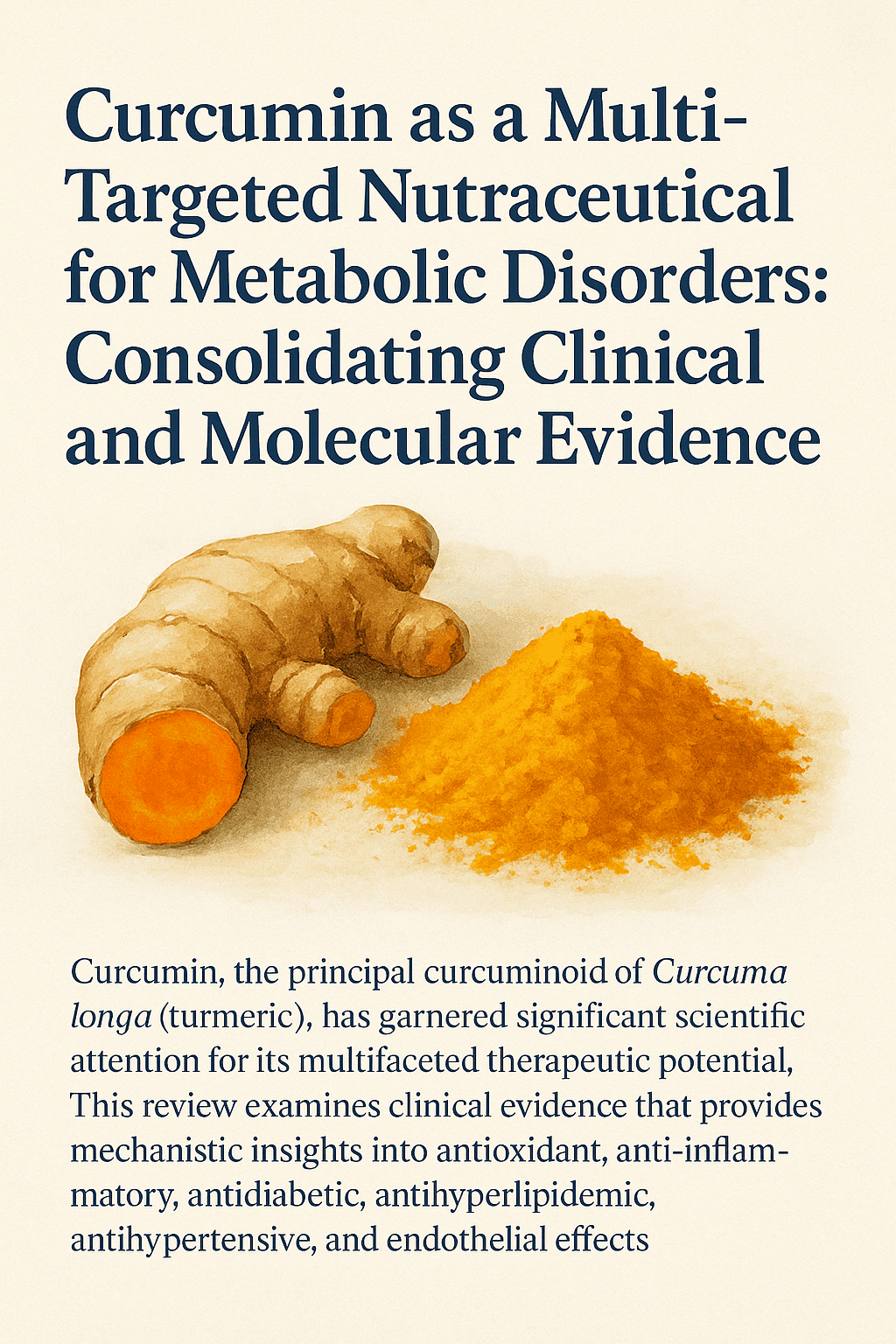
Curcumin as a Multi-Targeted Nutraceutical for MetabolicDisorders: Consolidating Clinical and Molecular Evidence

 https://doi.org/1234
Keywords:
oxidation inflammation endothelial function nutraceutical bioavailabilityAbstract:
Curcumin, the principal curcuminoid of Curcuma longa (turmeric), has garnered significant scientific attention for its multifaceted therapeutic potential. This review examines clinical evidence that provides mechanistic insights into antioxidant, anti-inflammatory, antidiabetic, antihyperlipidemic, antihypertensive, and endothelial effects. Results across diverse investigations indicate that curcumin intake improves biomarkers including total antioxidant capacity, superoxide dismutase, malondialdehyde, high-sensitivity C-reactive protein, interleukin-6, low-density lipoprotein cholesterol, high-density lipoprotein cholesterol, fasting blood glucose, HbA1c, QUICKI, HOMA-IR, and flow-mediated dilation. Curcumin may offer a low-toxicity complement to conventional therapy, although bioavailability and variable responses remain challenges.
1. Wang, Y.;Wang, J. Modelling and prediction of global non-communicable diseases. BMC Public Health 2020, 20, 1–13.
2. Peña-Oyarzun, D.; Bravo-Sagua, R.; Diaz-Vega, A.; Aleman, L.; Chiong, M.; Garcia, L.; Lavandero, S. Autophagy and oxidative stress in non-communicable diseases: a matter of the inflammatory state? Free Radical Biology and Medicine 2018, 124, 61–78.
3. Furman, D.; Campisi, J.; Verdin, E.; Carrera-Bastos, P.; Targ, S.; Franceschi, C.; et al. Chronic inflammation in the etiology of disease across the life span. Nature Medicine 2019, 25, 1822–1832.
4. Birben, E.; Sahiner, U.M.; Sackesen, C.; Erzurum, S.; Kalayci, O. Oxidative stress and antioxidant defense. World Allergy Organization Journal 2012, 5, 9–19.
5. Seyedsadjadi, N.; Grant, R. The potential benefit of monitoring oxidative stress and inflammation in the prevention of noncommunicable diseases (NCDs). Antioxidants 2020, 10, 15.
6. Beverly, J.K.; Budoff, M.J. Atherosclerosis: pathophysiology of insulin resistance, hyperglycemia, hyperlipidemia, and inflammation. Journal of Diabetes 2020, 12, 102–104.
7. Chitturi, S.; George, J. Hepatotoxicity of commonly used drugs: nonsteroidal anti-inflammatory drugs, antihypertensives, antidiabetic agents, anticonvulsants, lipid-lowering agents, psychotropic drugs. Seminars in Liver Disease 2002, 22, 169–184.
8. McGettigan, P.; Henry, D. Use of non-steroidal anti-inflammatory drugs that elevate cardiovascular risk: an examination of sales and essential medicines lists in low-, middle-, and high-income countries. PLoS Medicine 2013, 10, e1001388.
9. Hewlings, S.J.; Kalman, D.S. Curcumin: A review of its effects on human health. Foods 2017, 6, 92.
10. Nelson, K.M.; Dahlin, J.L.; Bisson, J.; Graham, J.; Pauli, G.F.; Walters, M.A. The essential medicinal chemistry of curcumin: miniperspective. Journal of Medicinal Chemistry 2017, 60, 1620–1637.
11. Karimi, A.; Naeini, F.; Niazkar, H.R.; Tutunchi, H.; Musazadeh, V.; Mahmoodpoor, A.; et al. Nano-curcumin supplementation in critically ill patients with sepsis: a randomized clinical trial investigating the inflammatory biomarkers, oxidative stress indices, endothelial function, clinical outcomes and nutritional status. Food & Function 2022, 13, 6596–6612.
12. Rodrigues, H.C.N.; Martins, T.F.P.; Braga, C.C.; Silva, M.A.C.; da Cunha, L.C.; de Araújo Sugizaki, C.S.; et al. Antioxidant and antiinflammatory response to curcumin supplementation in hemodialysis patients: A randomized, double-blind, placebo-controlled clinical trial. Clinical Nutrition ESPEN 2021, 44, 136–142.
13. Saraf-Bank, S.; Ahmadi, A.; Paknahad, Z.; Maracy, M.; Nourian, M. Effects of curcumin supplementation on markers of inflammation and oxidative stress among healthy overweight and obese girl adolescents: A randomized placebo-controlled clinical trial. Phytotherapy Research 2019, 33, 2015–2022.
14. Bateni, Z.; Behrouz, V.; Rahimi, H.R.; Hedayati, M.; Afsharian, S.; Sohrab, G. Effects of nano-curcumin supplementation on oxidative stress, systemic inflammation, adiponectin, and NF-κB in patients with metabolic syndrome: A randomized, double-blind clinical trial. Journal of Herbal Medicine 2022, 31, 100531.
15. Silva, T.A.L.; Medeiros, D.C.; Medeiros, G.C.B.S.; Medeiros, R.C.S.C.; de Souza Araújo, J.; Medeiros, J.A.; et al. Influence of curcumin supplementation on metabolic and lipid parameters of people living with HIV/AIDS: A randomized controlled trial. BMC Complementary and Alternative Medicine 2019, 19, 1–8.
16. Shafabakhsh, R.; Mobini, M.; Raygan, F.; Aghadavod, E.; Ostadmohammadi, V.; Amirani, E.; et al. Curcumin administration and the effects on psychological status and markers of inflammation and oxidative damage in patients with type 2 diabetes and coronary heart disease. Clinical Nutrition ESPEN 2020, 40, 77–82.
17. Pourhabibi-Zarandi, F.; Rafraf, M.; Zayeni, H.; Asghari-Jafarabadi, M.; Ebrahimi, A.A. The efficacy of curcumin supplementation on serum total antioxidant capacity, malondialdehyde, and disease activity in women with rheumatoid arthritis: A randomized, double-blind, placebo-controlled clinical trial. Phytotherapy Research 2024, 38, 3552–3563.
18. Panahi, Y.; Sahebkar, A.; Parvin, S.; Saadat, A. A randomized controlled trial on the anti-inflammatory effects of curcumin in patients with chronic sulphur mustard-induced cutaneous complications. Annals of Clinical Biochemistry 2012, 49, 580–588.
19. Sadeghi, N.; Mansoori, A.; Shayesteh, A.; Hashemi, S.J. The effect of curcumin supplementation on clinical outcomes and inflammatory markers in patients with ulcerative colitis. Phytotherapy Research 2020, 34, 1123–1133.
20. Pakfetrat, M.; Basiri, F.; Malekmakan, L.; Roozbeh, J. Effects of turmeric on uremic pruritus in end stage renal disease patients: a double-blind randomized clinical trial. Journal of Nephrology 2014, 27, 203–207.