Anesthetic Management of Symptomatic Chiari I Malformation in A Parturient; A Case Report
 https://doi.org/1234
Keywords:
Chiari I Malformation Neuraxial Anesthesia Intracranial Pressure Obstetric Anesthesia General Anesthesia Syringomyelia Cesarean Delivery Laryngospasm Deep ExtubationAbstract:
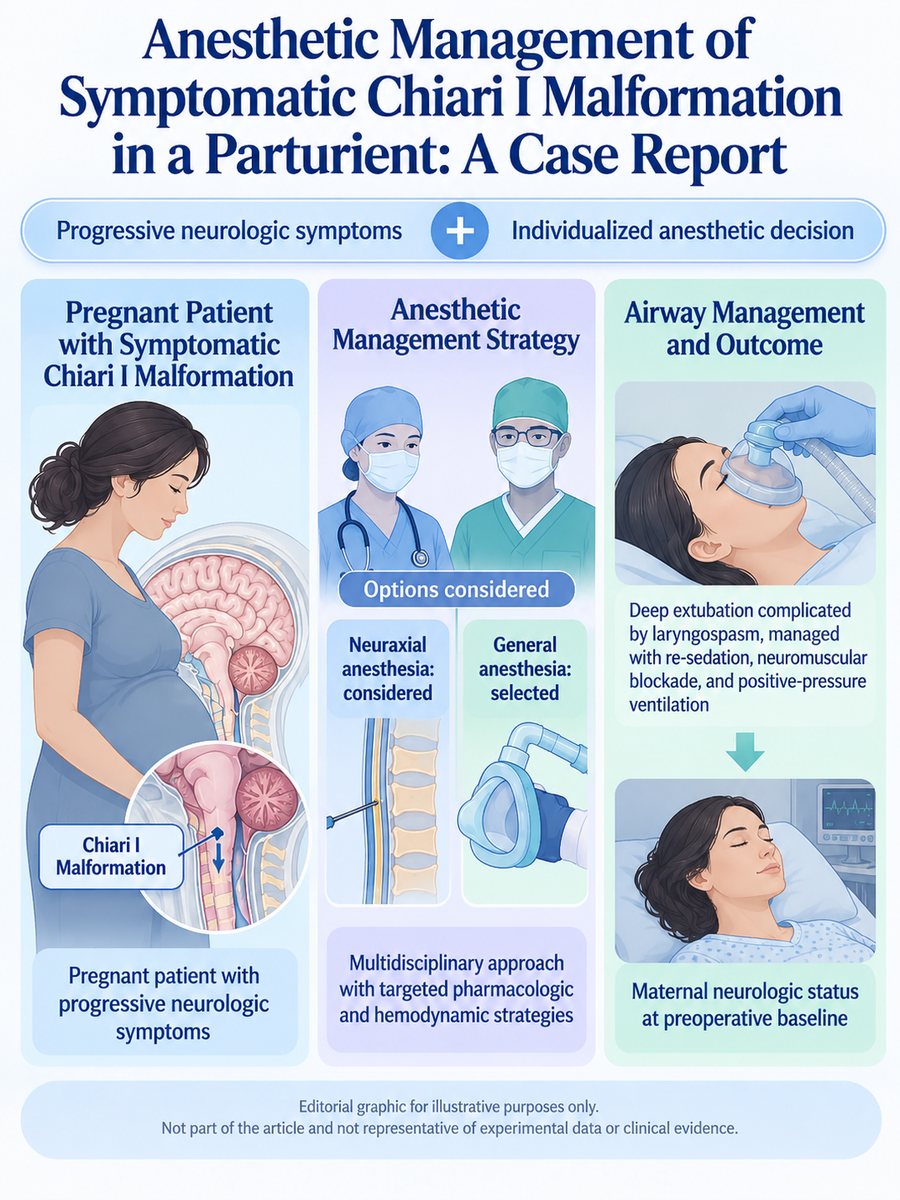
Anesthetic management of parturients with symptomatic Chiari I malformation requires individualized assessment, as both neuraxial and general anesthesia carry theoretical risk. With regard to neuraxial anesthesia, unintentional dural puncture may produce a cerebrospinal fluid pressure gradient, which can result in further neurologic deterioration. Additionally, manipulations involved in administration of general anesthesia, including direct laryngoscopy and endotracheal intubation, without optimal medication, can result in a hypertensive response and increased intracranial pressure. We report the case of a 25-year-old parturient with a Chiari I malformation, with associated progressive neurological symptoms, and a 14-mm cerebellar tonsillar descent, who underwent cesarean delivery under general anesthesia following multidisciplinary consultation. Targeted pharmacological and hemodynamic strategies were implemented to blunt sympathetic responses during airway management. Deep extubation was complicated by laryngospasm, requiring re-sedation and re-administration of a paralytic with positive-pressure bag-mask ventilation, after which the patient was neurologically at preoperative baseline. This case illustrates the competing neuraxial and general anesthetic risks involved in managing patients with symptomatic Chiari I malformation during pregnancy.
1. Oldfield EH, Muraszko K, Shawker TH, Patronas NJ. Pathophysiology of syringomyelia associated with Chiari I malformation of the cerebellar tonsils. Implications for diagnosis and treatment. J Neurosurg. 1994;80(1):3-15. doi:10.3171/jns.1994.80.1.0003
2. Milhorat TH, Chou MW, Trinidad EM, et al. Chiari I malformation redefined: clinical and radiographic findings for 364 symptomatic patients. Neurosurgery. 1999;44(5):1005-1017. doi:10.1097/00006123-199905000-00042
3. Leffert LR, Schwamm LH. Neuraxial anesthesia in parturients with intracranial pathology: a comprehensive review and reassessment of risk [published correction appears in Anesthesiology. 2014;120:1061]. Anesthesiology. 2013;119(3):703-718. doi:10.1097/ALN.0b013e31829374c2
4. Chantigian RC, Koehn MA, Ramin KD, Warner MA. Chiari I malformation in parturients. J Clin Anesth. 2002;14(3):201-205. doi:10.1016/S0952-8180(02)00342-2
5. Gruffi TR, Peralta FM, Thakkar MS, et al. Anesthetic management of parturients with Arnold Chiari malformation-I: a multicenter retrospective study. Int J Obstet Anesth. 2019;37:52-56. doi:10.1016/j.ijoa.2018.10.002
6. Wang LP, Paech MJ. Neuroanesthesia for the pregnant woman. Anesth Analg. 2008;107(1):193-200. doi:10.1213/ane.0b013e31816c8888
7. Benham-Hermetz J, Mitchell V. Safe tracheal extubation after general anaesthesia. BJA Educ. 2021;21(12):446-454. doi:10.1016/j.bjae.2021.07.003
8. Godoy DA, Rovegno M, Lazaridis C, Badenes R. The effects of arterial CO2 on the injured brain: Two faces of the same coin. J Crit Care. 2021;61:207-215. doi:10.1016/j.jcrc.2020.10.028
9. Garvey GP, Wasade VS, Murphy KE, Balki M. Anesthetic and obstetric management of syringomyelia during labor and delivery: A case series and systematic review. Anesth Analg. 2017;125(3):913-924. doi:10.1213/ANE.0000000000001987
10. Pulido S, Huang J, Mendoza-Elias N, Das P. Maternal, clinical, and radiographic outcomes: A retrospective analysis of anesthesia and delivery modality in Chiari I malformation. Neurosurgery. 2025;97(2):456-462. doi:10.1227/neu.0000000000003367
11. Metodiev Y, Brodbelt A, Kennedy N, et al. Anaesthetic management of obstetric patients with Chiari 1 malformation with or without syringomyelia: a multidisciplinary consensus statement from the Obstetric Anaesthetists’ Association (OAA). Int J Obstet Anesth. 2026;67:105189. doi:10.1016/j.ijoa.2026.105189